ARM-Based Hashing
A dive into high-efficiency cryptographic hashing. Unlike traditional GPU mining which consumes massive amounts of electricity, clustering ARM-based Single Board Computers (SBCs) offers a unique perspective on hash-per-watt efficiency for CPU-friendly algorithms.
ARM Hardware Setup
Building an ARM cluster requires combining multiple low-power boards (like Raspberry Pi, Orange Pi, or custom PCB clusters) to pool processing power. Each node requires adequate passive or active cooling and a reliable power delivery system.
1. The "Golden Rule": 64-bit
Verus mining requires a 64-bit environment.
- ■ CPU: Must be ARMv8-A or newer.
- ■ OS: You must run a 64-bit Operating System.
- ■ Raspberry Pi Note: Standard "Raspberry Pi OS" was historically 32-bit. Ensure you are flashed with the 64-bit version, or the miner will either fail or run at 10% speed.
- ■ Phone Note: Ensure the phone has a 64-bit CPU (Snapdragon 400 series or higher usually qualifies).
2. The Secret Weapon: AES
VerusHash uses AES encryption. This is the difference between making pennies and making dollars.
- ■ Hardware AES: High-end and mid-range ARM chips have "AES Hardware Acceleration" built-in.
- ■ Phones: Snapdragon 800-series (810+) and modern Samsung Exynos chips have this.
- ■ Orange Pi: The Orange Pi 5 (RK3588) is a "legend" in the Verus community with excellent AES support and 8 cores (6–9 MH/s).
- ■ Raspberry Pi: The Pi 4 and 5 support these instructions, but generally have lower hash rates than the Orange Pi 5.
3. RAM & Storage
Mining isn't RAM-heavy, but the system needs stability:
- ■ RAM (2GB Min): Enough to run a basic miner (like ccminer) on Linux or Android.
- ■ RAM (4GB+ Rec): If you plan on "Staking" or running a full node wallet.
- ■ Storage (16GB+): Plenty for the OS and the mining software.
4. Cooling (Non-Negotiable)
Mining runs your CPU at 100% load, 24/7.
- ■ Phones: Batteries are the weak point. Remove the battery and power directly via USB, or use a high-velocity fan. Heat = Swollen Batteries (Fire Hazard).
- ■ Pis: You must have a heatsink and an active cooling fan. Without one, the chip will "thermal throttle" and your hashrate will tank.
Hardware Comparison
| Device Type | Example Chip | Est. Hashrate | Power Draw |
|---|---|---|---|
| High-End SBC | Orange Pi 5 (RK3588) | 6.0 - 9.0 MH/s | ~8-10W |
| Flagship Phone | Snapdragon 8 Gen 1+ | 5.0 - 7.0 MH/s | ~5-8W |
| Standard SBC | Raspberry Pi 5 | 4.0 - 5.0 MH/s | ~7W |
| Budget SBC | Raspberry Pi 4 | 2.5 - 3.5 MH/s | ~5W |
| Cheap "Farm" Phone | Samsung A03s / Tracfone | 1.0 - 2.0 MH/s | ~3W |
Power & Efficiency
The Hash/Watt Ratio
The primary advantage of ARM-based hashing is the electrical efficiency. While a traditional GPU might draw 150-300 watts of power to generate its hashrate, an ARM node typically draws between 5 to 15 watts under full load. By clustering dozens of these nodes together, it's possible to achieve a highly competitive Hash-per-Watt ratio, radically lowering operational overhead and thermal output.
Current Garage Deployment
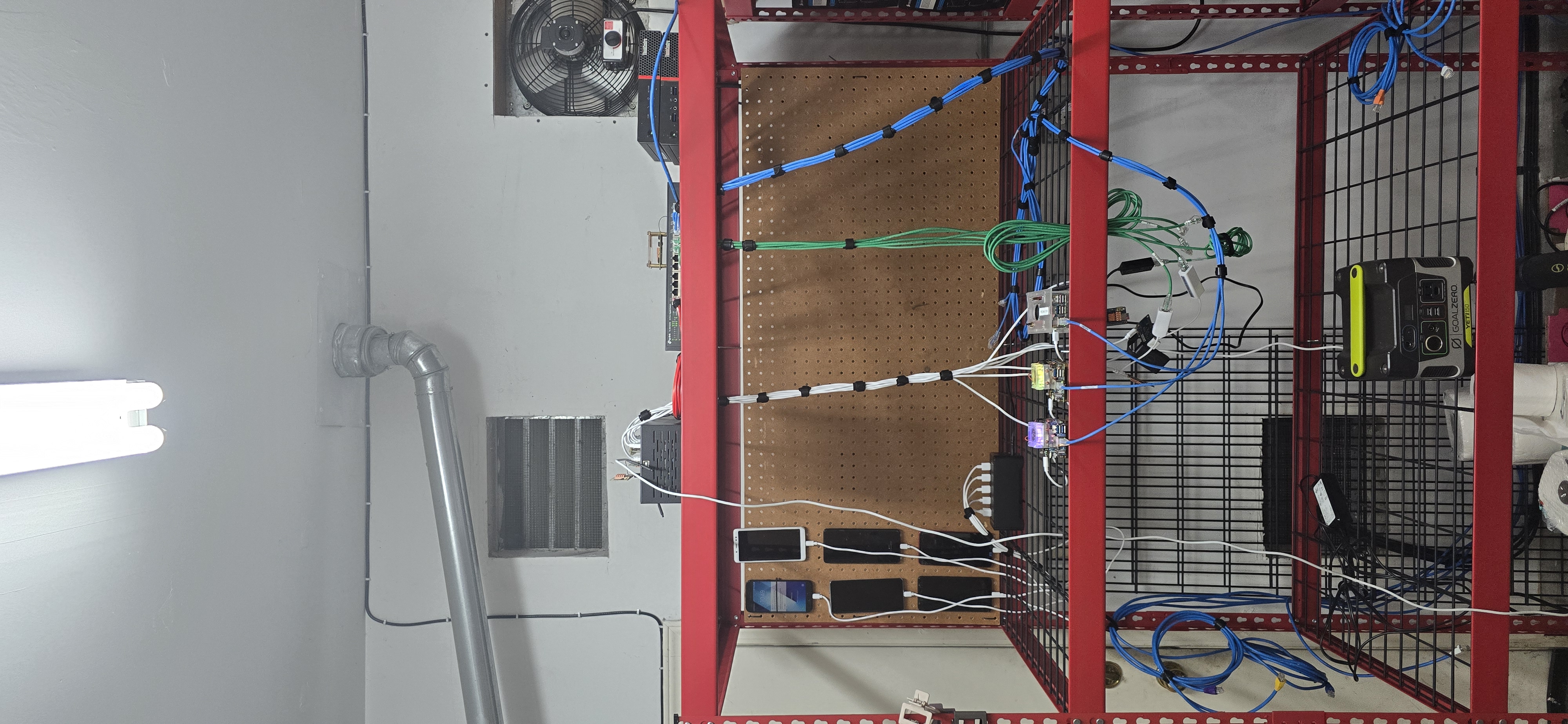
My current active deployment in the garage consists primarily of smartphones. I sourced several devices from mainland China, specifically Xiaomi (3 devices) and Oppo (2 devices). In my experience, the Oppo phones have proven much more stable under continuous load, though the Xiaomis might simply be older or faulty units. The rest of the farm relies on Samsung devices—while they are the most expensive in terms of hardware cost-per-megahash ($/MH), they run the most consistently.
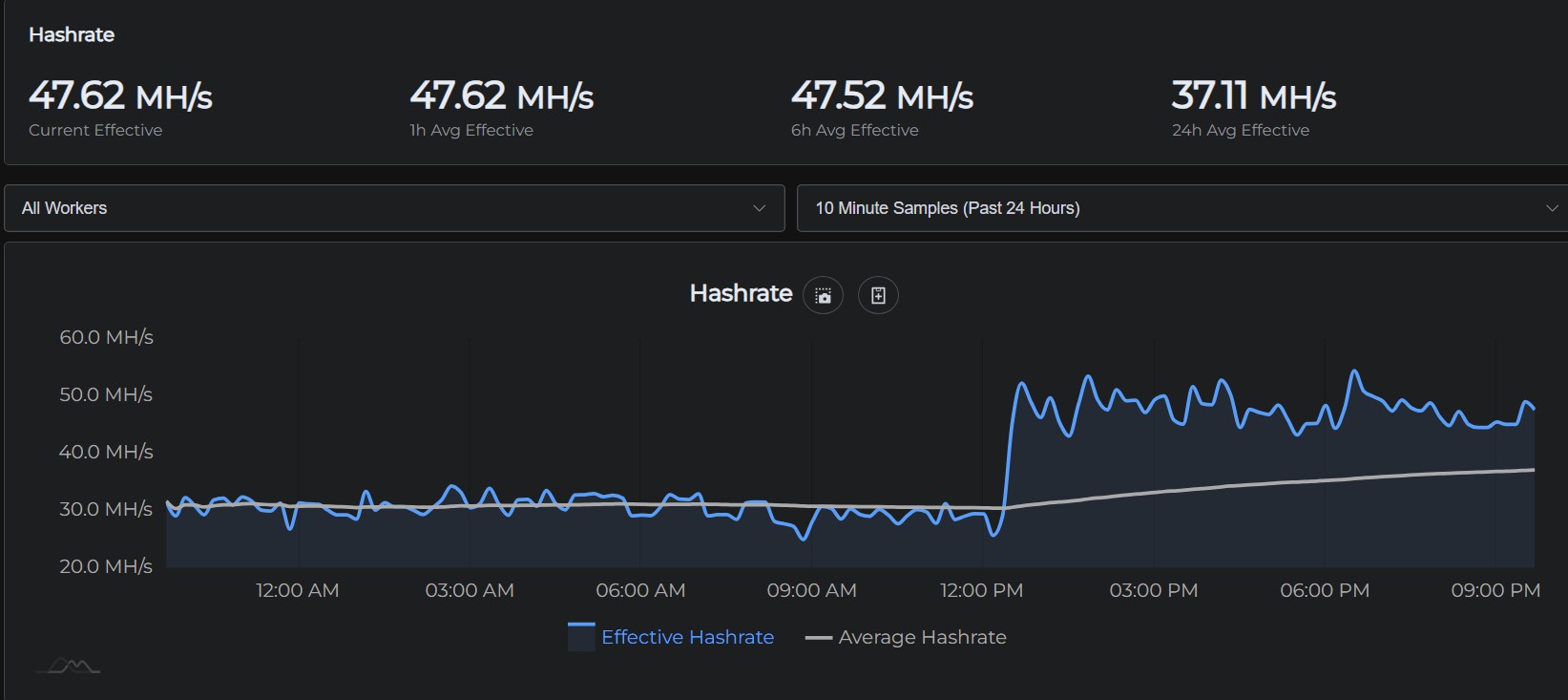
Pool Hashrate Performance
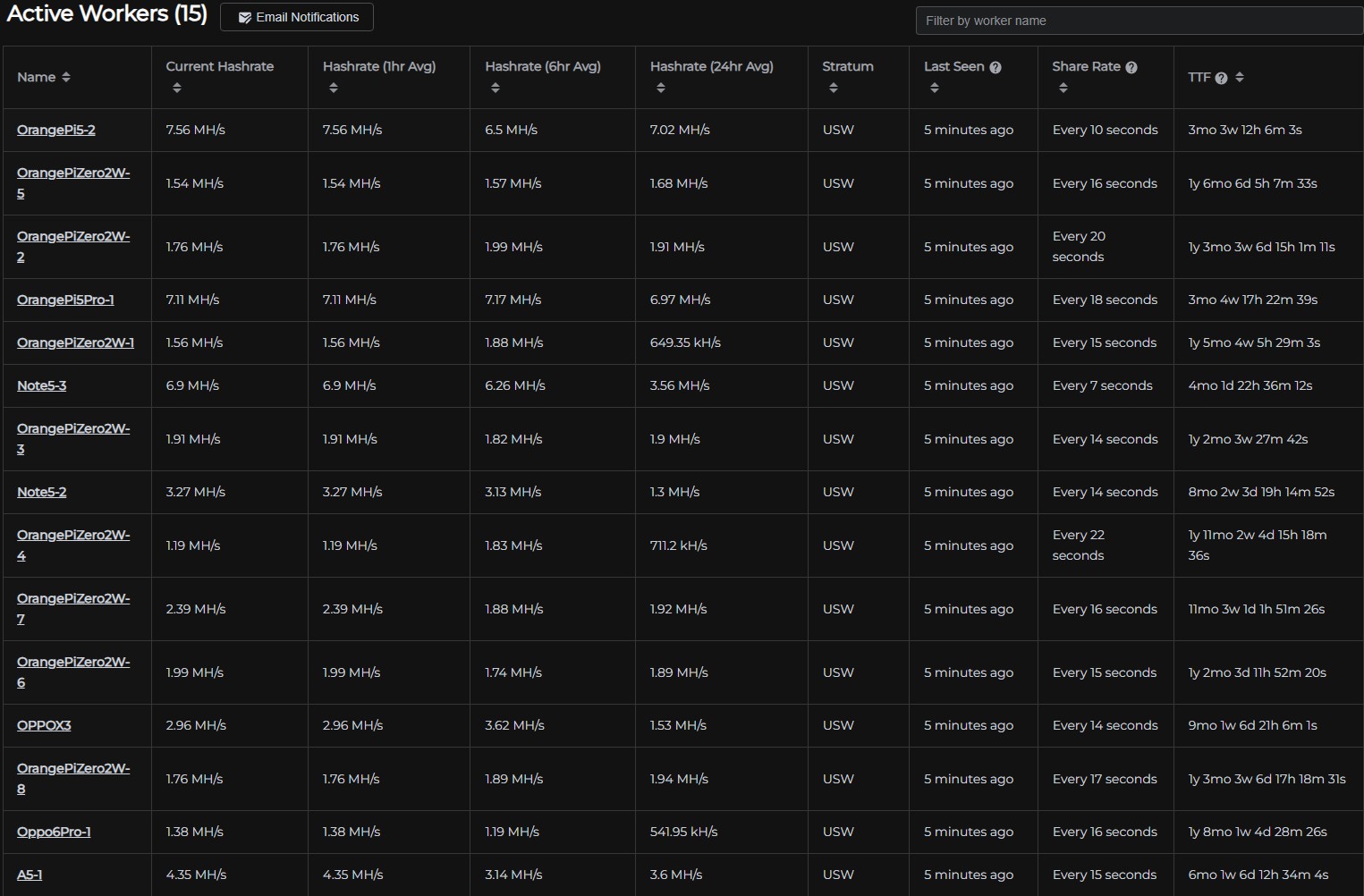
Active Worker Nodes
Project Summary
This project is still ongoing, and to be completely transparent, it is not profitable at all. It generates only a few cents a day in cryptocurrency, meaning I am actually losing a few pennies daily once electricity costs are factored in.
The initiative started simply because I had some old phones lying around and picked up some really cheap devices while I was in China. However, to scale the cluster and test higher-efficiency nodes, I did end up purchasing dedicated SBCs: specifically seven Orange Pi Zero 2Ws and three Orange Pi 5 series boards. Ultimately, this build is an exploration of ARM architecture, clustering capabilities, and maximizing hash-per-watt efficiency rather than a money-making venture. Worst case scenario, if the mining experiment concludes, I can easily repurpose the Orange Pis for other homelab-related projects.